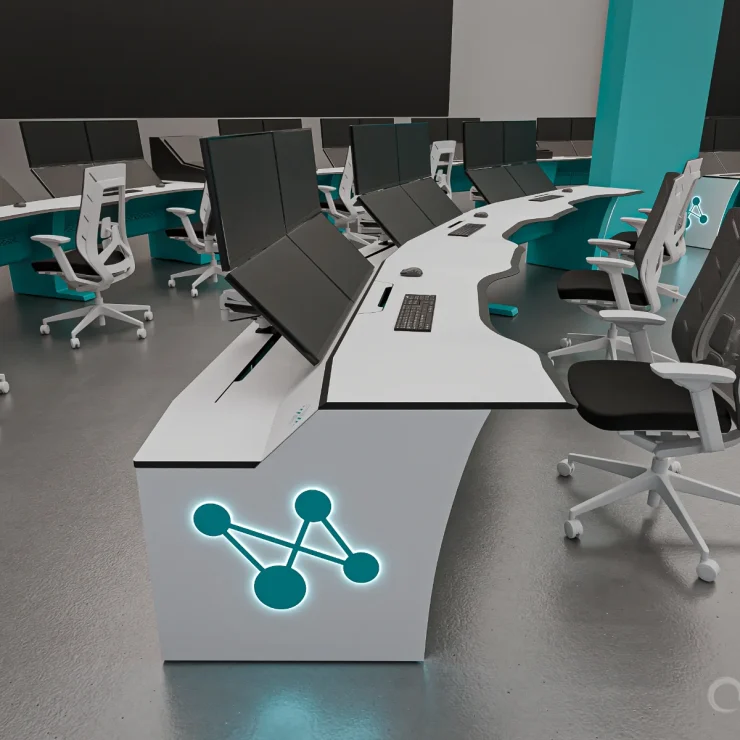

Industrial Dispatch Control Console
An 11-meter multifunctional dispatch console developed for Armer Engineering.
A project shaped by strict time constraints, where design, engineering and production had to align with precision — and without margin for delay.
Design — Denis Zarembo
Challenge:
The task was to develop a modern dispatch console and take full responsibility for the project — from design to production and installation.
The key constraint was time.
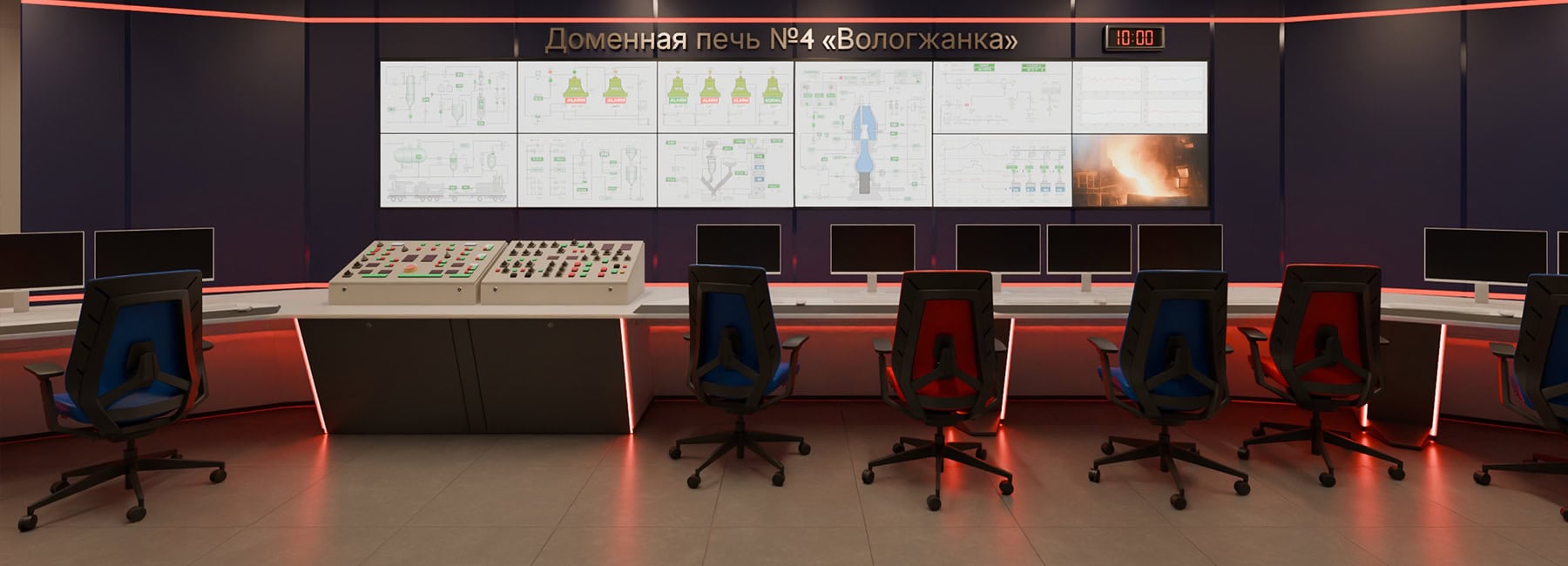
The console was part of a much larger transformation. During the shutdown of a blast furnace, the entire control room had to be rebuilt — including interiors, system reconnection and installation of operator workstations.
This window could not exceed 90 days.
Within that timeline, the console itself had only one week allocated for installation. That meant every decision — from design to manufacturing — had to be precise and predictable.


Solution:
Under these conditions, we focused on optimizing the process at every stage. From the very beginning, we worked to reduce uncertainty — both in design and in execution.
To accelerate early exploration, we used Midjourney as a tool for rapid visual iteration.
It allowed us to move from abstract discussions to tangible design directions much faster, narrowing down options and improving clarity.
This reduced the design and approval phase to two weeks, while still allowing space for detail and refinement.


One of the core requirements was a seamless surface — a monolithic tabletop without visible joints. This led us to select Hanex solid surface material by Hyundai.
The material allowed us to achieve perfectly smooth planes through bonding and polishing, eliminating seams entirely. It also opened the possibility to go further — to build not just the surface, but the entire structure using the same material.
Through thermoforming, we developed a complex geometry with non-standard angles and transitions, maintaining both visual continuity and structural integrity.


But the most critical shift in this project was not only in design or material — it was in the process itself. Instead of following a traditional linear workflow, we chose to rethink how the project would be assembled.
In a standard scenario, system integration and wiring would begin only after the console installation. This would have extended the timeline and introduced additional risks. We approached it differently.


We designed and delivered pre-assembly mounting stands ahead of time. While the console was still in production, the client was able to complete wiring and system integration in parallel.
By the time the console arrived on site, the technical groundwork was already done. Installation became a matter of assembling and enclosing the prepared systems.
This decision reduced the overall project timeline by 2–3 weeks — and significantly lowered the pressure on the final installation phase.
Result:
This project became a defining moment for us. It demonstrated how design, engineering and product management can operate as a single system — especially under tight constraints.
The result is a console that is precise, reliable and visually cohesive.
For the client, it is not only a functional tool for managing complex industrial processes, but also a workspace designed with clarity and intention.
Working on a control center?
We can support both design and engineering — from concept to implementation.